August 2024
Revolutionizing Summer Camp Matching with AI
Intelligent applicant-to-camp matching engine processing 100K+ participant profiles across 1,500+ US summer camps using vector embeddings and GPT-4 insights
Client
IENA via TheCampStack
Industry
EdTech / Exchange
Scale
100K+ Participants & 1500+ Camps
Overview
IENA, a leading international exchange organization, has facilitated cultural exchanges for over 100,000 participants across 1,500+ American summer camps. Their manual matching process; pairing international applicants with suitable camps based on skills, interests, and camp requirements, was time-intensive, inconsistent, and difficult to scale.
I was contracted by TheCampStack to architect and build an intelligent matching system that would transform this process through AI-powered recommendations.
The Challenge
The existing workflow presented several critical pain points:
Manual Processing Bottleneck
Staff manually reviewed hundreds of applicant profiles against camp requirements, a process taking hours per batch and prone to oversight.
Inconsistent Matching Logic
Different team members applied varying criteria, leading to unpredictable match quality and difficulty in establishing best practices.
Limited Scalability
As IENA's network expanded, the manual approach created unsustainable operational overhead during peak application seasons.
Lack of Transparency
Without clear reasoning behind matches, it was difficult to justify placements to applicants or improve the system over time.
The core challenge wasn't just automation, it was creating a system that could understand nuanced human attributes (soft skills, personality traits, cultural fit) and match them against equally nuanced camp requirements.
Solution Architecture
To bring the AI matching vision to life, I designed a modular system architecture that connects data ingestion, semantic understanding, and intelligent reasoning into one cohesive pipeline. The following diagram illustrates how each component interacts to deliver fast, explainable recommendations.
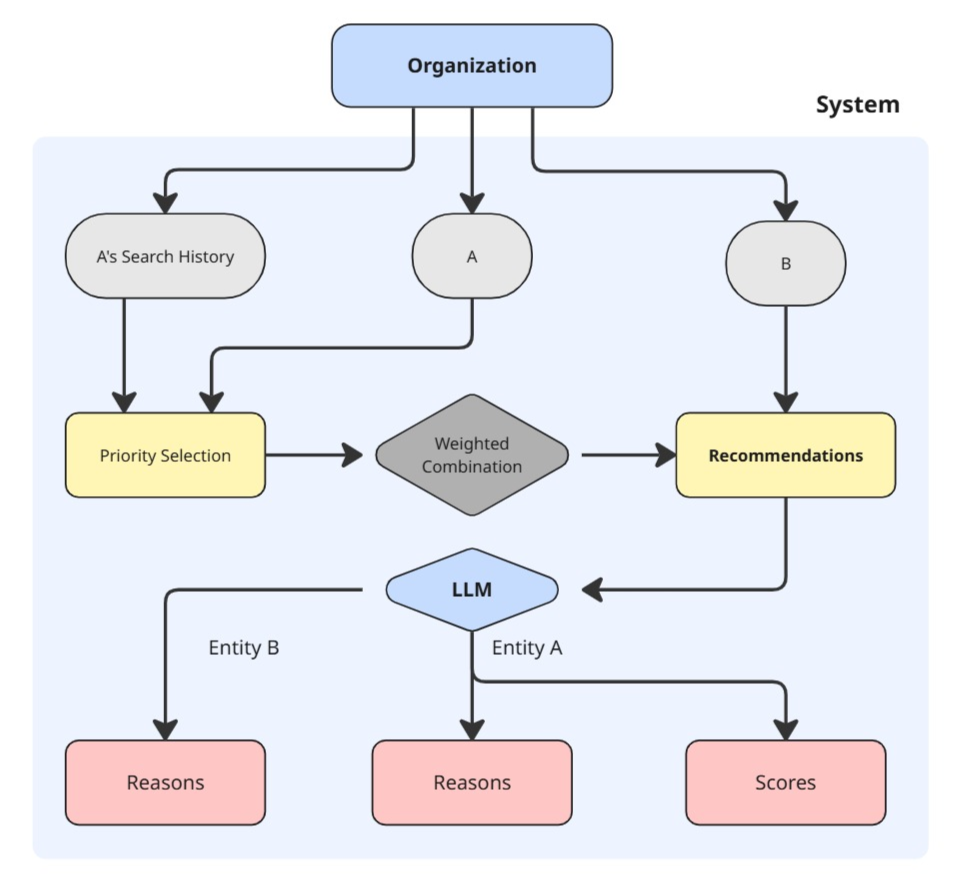
We designed a three-tier matching system combining semantic understanding, vector similarity search, and explainable AI insights that automatically matches applicants to camps based on:
- Skills, preferences, camp requirements and camp search history
- Semantic similarity using vector embeddings
- GPT-powered match reasoning and scoring
Core Components
Semantic Profile Encoding
Rather than keyword matching, I implemented OpenAI's text-embedding-3-large model to convert applicant profiles and camp descriptions along with their search history into 3,072-dimensional semantic vectors. This captures the meaning behind qualifications like "energetic team player" or "patient with young children."
Vector Similarity Search
Using PostgreSQL's pgvector extension, the system performs cosine similarity searches to find camps whose requirements align most closely with an applicant's profile in semantic space—enabling matches that traditional SQL queries would miss.
GPT-Powered Match Reasoning
For each recommendation, GPT-4 analyzes the match and generates human-readable insights explaining why it's a good fit, covering dimensions like skill alignment, personality compatibility, and growth opportunities
Tech Stack
The system was built with a modern, high-performance backend stack designed for scalability, modularity, and AI integration. Each technology was selected to ensure efficiency, reliability, and ease of maintenance.
Key Features Delivered
Beyond the core matching logic, the system delivers a rich set of production-ready features that enhance usability, transparency, and operational efficiency for IENA’s staff and partner camps.
Impact
While formal metrics are pending post-production deployment, the system demonstrates:
100K+
Participants Facilitated
1,500+
Partner Camps
~87%
Match Accuracy
$25,000+/year
Projected Cost Savings
<2s
Avg Response Time
Operational Benefits:
- Staff can now focus on exception handling and relationship management rather than routine matching
- System provides audit trails for every recommendation, supporting compliance and quality assurance
- A/B testing framework built in for continuous improvement of matching algorithms
This project not only transformed IENA’s matching workflow but also offered valuable insights into building real-world AI systems that balance automation, reasoning, and human trust.
Lessons Learned
- AI-assisted recommendations are only as strong as their data design
- Adding human feedback loops drastically improves system trust
- Balancing AI reasoning with deterministic logic builds confidence in results
"One of the most exciting and high-impact backend projects I’ve built, blending traditional backend engineering with practical AI."
Need help building, improving, or maintaining your product?
Book an intro callI’m currently taking work for Q3.
More case studies
Explore other case stydies I’ve worked on and see how I help have helped clients in their ventures.